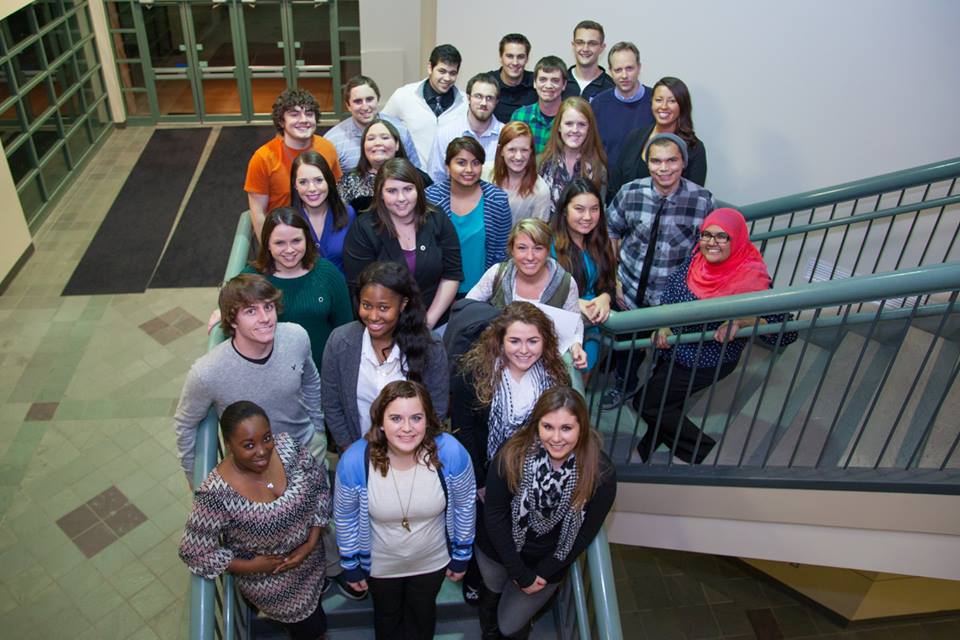
Fun times at #CMANYC15

It’s been nearly one month since SCJ took the College Media Association’s Spring New York City Convention by storm!

Thanks to our Buena Vista, Marywood, and Robert Morris chapters for submitting your CMA photos!

Next stop: Austin, Fall 2015!

President’s Post: That week when one journalist and one non-journalist broke my heart…

(Or…why accountability really is what it’s all about)

BY Andrea Frantz, Ph.D.
SCJ President

I’m not going to lie. This week was pretty heartbreaking.

Was it because Walking Dead fans had to relive the deaths of Tyreese and Beth? Nope. As long as Michonne lives, that’s all that really matters. Was it because Kanye West didn’t actually speak into the microphone when he (again) stormed the stage following a Beyoncé loss? Decidedly not. I could go many years without more words of wisdom from Kanye and be just fine, thanks. Was it because friends in New England were again looking at being buried in more of winter’s fury? Well, admittedly, I’m feeling a lot of sympathy there, but no. I’m an Iowan. Weather is a constant, but it never breaks us. Am I heartbroken over more naysayers on childhood immunizations? Oh, I’ve got a lot of frustration and anger, but no heartbreak.

No, my heartbreak comes from the loss of two influential voices in journalism. One of them calls himself a journalist but may have temporarily or occasionally forgotten the journalists’ code: SPJ’s edict to ‘Seek the Truth and Report It.” The other would never call himself a journalist, but did more to raise awareness of political and social issues as a satirist than most journalists.

My heart cracked initially when NBC Nightly News anchor Brian Williams was suspended because he ‘misremembered’ an experience he hearkened to several times over the past dozen years. He apparently was not in a Chinook helicopter that was shot down in Iraq, though he has claimed several times that he was. And in the wake of that revelation, new questions have arisen about the veracity of other reports, specifically during Hurricane Katrina and its aftermath.

But my heart officially shattered when Jon Stewart, perhaps this generation’s greatest political and social satirist, announced his departure from The Daily Show. The Comedy Central anchor show is—for better or worse—the means by which so many of my students actually learn about what’s going on in the world.

First, let me address the Williams loss. Network anchors are journalists. Journalists are bound by the SPJ Code of Ethics. They need to know it, practice it, and call out those who violate its tenets. Those news outlets that have questioned and pursued the truth of this case are right to do so. NBC had no choice but to suspend Williams if there is even a small question of his credibility.

Because, in the end, it is credibility that’s at the heart of journalism. The nightly news anchor has long been seen as the face of the network. It’s Peter Jennings’s voice and face I will always associate with some of the most important stories of my adult life: the Space Shuttle Challenger disaster; the 9/11 terrorist attacks, the Bosnian war. I lived those experiences with Peter Jennings in my living room. And I am no different from millions of Americans. People come to associate lived and shared social experience with the person or people who deliver the news of that experience.

Unrealistic as it may be, we tend to hold those media leaders to a higher standard than everyone else, because they are a constant and because we feel we know them. Williams, as not only anchor but also Managing Editor of NBC Nightly News, represented the network and the field at its highest level. I’m no psychologist; thus, I won’t try to address the faulty memory claim. It may well be true that he’s misremembered. The brain can be a funny thing. But when journalists become the news, and when memes and hashtags poking fun at journalistic integrity flood social media, the field is irreparably damaged.

https://twitter.com/scrowder/status/565173382342123520

So, heart cracked.

And then it shattered when coming on the heels of the Williams disappointment, Jon Stewart announced his departure at the end of the year from Comedy Central’s The Daily Show. Why am I including this comedian, who has long maintained “I don’t want to be a journalist; I am not a journalist” in with my lament for the field of journalism this week?

Again, it comes back to accountability. While Jon Stewart and his team at The Daily Show may not be journalists, per se, what they do for the field on a regular—indeed unrelenting—basis is hold the field of journalism (and yes, politicians, educators, and…OK, people in general) accountable for their public statements and actions. All. The. Time. And this is precisely what we should all be doing in the field every day. But we don’t. So we need the Jon Stewarts and Stephen Colberts out there to challenge us to rethink the very nature of truth, what we believe, and why we believe it.

Americans love entertainment and gravitate to it over straight information consistently. Why read about the complicated political machinations of Ukraine and pro-Russian rebels when we can watch Entertainment Tonight and hear Seth Myers nominate Russian President Vladimir Putin to the ALS ice bucket challenge? We just have to think less on the latter story, and in this information age in which we are bombarded by so much information, sometimes folks need to take it with a spoonful of sugar. Or so my students frequently tell me.

So while Jon Stewart’s riffs on news and news reporting are never delivered with even a modicum of sugar, there’s something to be said for getting people to pay attention to issues even while they’re laughing. Stewart’s dedication to political and social satire is a journalistic service, something that goes beyond entertainment. He has challenged the field of journalism to be accountable, and when it’s not, he’s called offenders out.

If the Brian Williamses of journalism are inevitable, we need the Jon Stewarts to hold up the mirror and answer the question, ‘Who’s the least ethical of all?’ Satire, when it’s done as well as it has been by The Daily Show, is the counter force when the reality of our human limits gets too weighty.

Are they both losses? Absolutely. When we lose smart voices in media it’s always a loss. But it’s Stewart’s voice I’m going to miss most because I’m afraid that journalism accountability will require yet more skewering down the line.

1499499_714671640617_1379616982_nAndrea Frantz, Ph.D. is associate professor of digital media at Buena Vista University, Iowa. She was installed as SCJ President at the 2014 Biennial. She’s an advocate of student journalists and the First Amendment. She’ll be blogging periodically about SCJ and other news.

President’s Post: SCJ taking a bite of the Big Apple

Students from across the country will again converge on the media capital of the world, New York City, March 11-14 to participate in the College Media Association convention.

In addition to all of the traditional perks of attending CMA in New York (i.e., the best media tours on the planet; the New York CMA Photo Shoot Out; and, of course, Nuts 4 Nuts on nearly every street corner), we hope that all of our SCJ members will participate in several SCJ-sponsored events.

First, SCJ’s national office will be sponsoring the advisers’ lounge and doing a meet and greet on Thursday, March 12. We’ll announce our location via a flyer in everyone’s registration bag, and hope you’ll consider dropping in, partaking of some refreshments and meeting some of the Executive Council members.

We’re also excited that SCJ will offer several fun, interactive sessions at the conference. Student Press Law Center’s Executive Director, Frank LoMonte, and the Newseum Institute’s Chief Operating Officer, Gene Policinski will team up in a rapid-fire session that explores the top 10 First Amendment challenges facing student media today. This session will be followed by a fast and furious First Amendment Trivia showdown led by myself and joined by the aforementioned First Amendment dynamic duo. This is a session you won’t want to miss because there will be some fun 1A swag to be won.

Ever wonder why judges for media contests make the decisions they do? SCJ Vice President Lindsey Wotanis will lead a session #Winning: Why Contests Matter that addresses that question and more. Previous and current SCJ national contest and Pacemaker judges will take on the challenge of judging student work in the moment during this session to offer students some insights into the qualities that make an entry rise to the top.

Be looking for these opportunities and more to enhance your CMA New York experience in March. See you in the Big Apple!


1499499_714671640617_1379616982_nAndrea Frantz, Ph.D. is associate professor of digital media at Buena Vista University, Iowa. She was installed as SCJ President at the 2014 Biennial. She’s an advocate of student journalists and the First Amendment. She’ll be blogging periodically about SCJ and other news.

CORRECTION: Wrong email listed in Contest Rules

SPJ Code of Ethics, Part 4: Be Accountable and Transparent.

Bullet 3: Acknowledge mistakes and correct them promptly and prominently. Explain corrections and clarifications carefully and clearly.

Yep. We goofed! We’re so very sorry.

The email address listed in the SCJ 2015 Contest Rules is incorrect. It read: scjnational@gmail.com.

Our actual working email address is scjnationaloffice@gmail.com.

As you may have noticed, we’re in a period of transition as we update our web presence. We accidentally listed the wrong address in our contest rules.

IMPORTANT: If you’ve already submitted entries to the contest, we didn’t receive them! Please forward any entries sent to the incorrect address to the correct address, which again, is scjnationaloffice@gmail.com.

If you haven’t sent your entries yet, phew! Please use the following link to access the updated 2015 SCJ Contest Rules that now list the correct address throughout the document.

Should you have any questions about whether your entries made it to us, please contact our Contest Director, Mary Beth Earnheardt, directly at mearnheardt@ysu.edu.

We apologize for the error, and we look forward to another successful contest!


logo_cornerGot contest questions? Contact SCJ’s VP of Contests, Dr. Mary Beth Earnheardt, at mearnheardt@ysu.edu.

President’s Post: SCJ and CMA form partnership for future conferences

Look for some exciting changes in the coming months for SCJ.

Following the 2014 SCJ Biennial conference held at Bethany College in Bethany, WV, Executive Council members responded to delegates’ challenge to boost national profile and participation in our every other year gathering.

We needed to look no further than Lori Brooks, Associate Executive Director of College Media Association (CMA). CMA offers arguably the nation’s most active gatherings for student media leaders twice yearly in cities known for vibrant, active media. Let’s face it; is there a media mecca more exciting than New York City?

College Media Association’s conventions have long set the standard for how to put together thought-provoking speaker line-ups; engaging hands-on workshops; and valuable educational coaching through critique and mentoring services. In short, colleges and universities want to go to CMA at least once a year, and in this day and age of shrinking travel budgets many of us had to make the painful decision to cut out other travel in order to do so.

As a result, SCJ Executive Council members proposed to strengthen an already good partnership with CMA, which Brooks and President Rachele Kanigel immediately welcomed.

What does this mean for SCJ chapters?

  • Beginning in fall 2016, SCJ will host its biennial meeting in conjunction with CMA’s fall convention in Atlanta, GA. Chapters will be encouraged to arrive a half day early and participate in SCJ’s workshops and then stay and enjoy all of the excitement of CMA’s convention offerings.
  • SCJ will now look to announce its major awards (including the Sheridan Barker Award for Adviser of the Year and the Arthur H. Barlow Student Journalist of the Year) at the CMA fall conventions in the special session dedicated to advising awards.
  • At both the fall and spring CMA conventions, SCJ will propose and sponsor sessions designed specifically for SCJ chapters that address key student media issues. We’ve already scheduled some exciting sessions for New York 2015 that address First Amendment questions and also the value of entering student work in national contests.
  • Each spring, SCJ will host a day at the CMA Adviser’s Lounge, where chapter advisers and those interested in learning more about SCJ can relax and meet each other and Executive Council members.

And this is just the beginning…We hope that these changes will excite even more chapters to engage and contribute to our growing ranks.

We’re excited to see you in New York!


1499499_714671640617_1379616982_nAndrea Frantz, Ph.D. is associate professor of digital media at Buena Vista University, Iowa. She was installed as SCJ President at the 2014 Biennial. She’s an advocate of student journalists and the First Amendment. She’ll be blogging periodically about SCJ and other news.

President’s Post: Why unpopular speech needs our protection

je_suis_charlie_fist_and_pencilFair warning: this blog post is likely to offend. I’m about to advocate for those who make it their business to piss people off.

As I write this, French police are on the brink of apprehending the terrorists who attacked the Charlie Hebdo offices in Paris and killed 12 staff members there on January 7.

The presumed motive for the bloodshed? Most agree that the killers were offended by the messages communicated in editorial cartoons published in the magazine, though specifics should become clearer when the killers are brought to justice.

Yes. The magazine’s editorial cartoons—indeed much of its editorial content—had the potential to offend. But that is the very nature of political and social satire. It’s the rhetorical risk takers—the folks who stick their necks out and say publicly what others will only say behind closed doors—who are among the leaders in fostering free and open public discussion about the difficult issues of the day. Charlie Hebdo’s editors knew they were taking risks, but they took them knowingly and intentionally because to silence public conversation is to ensure that only the very few and powerful will have a voice in social and political issues. And silencing of any kind is simply not acceptable. They understood as Mark Twain once wrote, “Courage is resistance to fear, mastery of fear—not absence of fear.”

One of the most important modern defenses of unpopular speech can be found in the U.S. Supreme Court’s unanimous ruling in Hustler Magazine v. Falwell (1988). Justice Rehnquist, writing for the majority noted:

Despite their sometimes caustic nature, from the early cartoon portraying George Washington as an ass down to the present day, graphic depictions and satirical cartoons have played a prominent role in public and political debate…[T]he fact that society may find speech offensive is not a sufficient reason for suppressing it. Indeed, if it is the speaker’s opinion that gives offense, that consequence is a reason for according it constitutional protection. — Hustler Magazine, Inc. v. Falwell, 485 U.S. 46 (1988)

Provocative messages are not hard to locate in international media coverage; Charlie Hebdo’s cartoons were neither the first to outrage, nor the most vitriolic. One needs only to look to Westboro Baptist Church funeral shenanigans to find equally repugnant public messages designed to insight outrage.

Yes. We are obligated to raise important ethical concerns that ask: ‘just because we can, does it mean we should?’ Is offense for the sake of offense instructive or socially valuable? Is speech that lampoons or belittles a specific group of people based on race, sex, sexual orientation, or religious preference hate speech? I don’t plan to answer these questions here. They’re tough ones and worthy of debate. But here’s the thing: debate is precisely what Charlie Hebdo and others advocate by challenging the status quo. We all have a choice as to whether we engage in the verbal sparring that political satire seeks to inspire. That choice happens when messages are made available. Conversely, choice disappears when silence is imposed.

What does a terrorist attack in France have to do with American student journalists?

Plenty.

Challenges to free speech happen all too frequently on college campuses across our nation and it is imperative student journalists know how to respond. For example, recently the University of Iowa’s administration chose to quickly remove from the campus a piece of public art in the form of a hooded Ku Klux Klan member. The figure was covered with newspaper articles that chronicled America’s long-standing racial tensions. The figure was shocking to many who saw it, and though it only stood in the U of I’s free speech zone for a few hours, it inspired outrage and a great deal of conversation. According to an Iowa State Daily article, while the artist was asked to remove the piece under the auspices of not having secured the proper permits to display it, SPLC Executive Director, Frank LoMonte noted, “”It’s hard to start dialogue about something upsetting without showing something upsetting,” Indeed. But if the dialogue was stopped through physical removal of the art, it was incumbent of the student journalists to pick up that mantel and continue it.

Journalists learn to challenge the status quo often for the first time in college. They do it, not unlike Charlie Hebdo, with cartoons, editorials, and asking tough questions when news happens. The creative social critics who employ satire often receive a great deal of push back, sometimes from peers, other times from university administrators or faculty. And when media backs down or is silenced, the conversation stops.

Real social change happens when hard conversations take place. It’s the role of journalists to push the envelope, and yes, sometimes shock or offend. But student media leaders should always weigh the consequences of such action and take these risks knowingly.


1499499_714671640617_1379616982_nAndrea Frantz, Ph.D. is associate professor of digital media at Buena Vista University, Iowa. She was installed as SCJ President at the 2014 Biennial. She’s an advocate of student journalists and the First Amendment. She’ll be blogging periodically about SCJ and other news.

2015 Contest Rules Now Available

Chapters! It’s the most wonderful time of the year–Contest Time!

Here’s the link to this year’s contest rules: 2015 SCJ Contest Rules

Please note one important change to this year’s contest is the entry deadline. We moved the deadline back by one month to allow chapters more time to prepare their materials. And because, let’s face it, nobody likes a deadline on New Year’s Eve!

Here are the general rules. For specifics on categories, please see the PDF link above.

General Rules:

THERE ARE NO FEES & ALL CATEGORIES ARE PROFESSIONALLY JUDGED

    1. Only active chapters of SCJ and their initiated members are eligible to participate.
    2. All entries must have been published or broadcast in the calendar year 2014 except the submissions for overall excellence in the online categories. The online entries will be judged at times selected by the judges.
    3. This year all categories except yearbook are online entry. All entries (except yearbook) should be sent to scjnational@gmail.com. All email entries must be date-stamped no later than January 31, 2015.
    4. Entries for Newspaper Overall Excellence are as follows: Three complete issues published on or nearest the 2014 dates of March 15, October 15 and December 1. Yearbooks: one complete copy; no tearsheets. Magazines: all (up to four) consecutive issues.
    5. Stories in a series or continuing coverage may be submitted as one entry.
    6. No more than three entries from each chapter may be submitted in any individual category. Submit only entries of high quality, which merit attention.
    7. Improperly prepared, or late, entries will be disqualified.
    8. No entries will be returned to chapters of individual members. Where possible, judges’ comments will be published with awards listings on scjnational.org and disseminated over the email list.
    9. The SCJ Contest Director has final say over contest decisions. For example, if too few entries are received in any category the contest director may choose to eliminate the category.
    10. All work must have been produced by a student member of an SCJ chapter and must have appeared in a student publication or website or aired on a student broadcasting facility. The contest is not for faculty or staff of the university or for work that has been edited or worked on by outside professionals.
    11. If appropriate, attach a statement of no more than 100 words explaining unusual circumstances under which an entry was published or broadcast. For example, you may want to put a news story in context, describe action that resulted from it, or detail difficulties encountered in gathering information. All statements must be typed and attached to the email entry in the appropriate category.
    12. Entry deadline is January 31, 2015. All entries must be postmarked for yearbook or date-stamped for the other categories by this date. Late entries will be discarded.
    13. Send entries to: scjnational@gmail.com
    14. Yearbook entries should be mailed to:

Mary Beth Earnheardt
SCJ VP of Contests
Youngstown State University
English Department
1 University Plaza
Youngstown, OH 44555


logo_cornerGot contest questions? Contact SCJ’s VP of Contests, Dr. Mary Beth Earnheardt at mearnheardt@ysu.edu.

Marywood University inducts 10 new members

Congrats to the Marywood University SCJ Chapter on its recent initiation of 10 new members, bringing their total current Chapter membership to 26 members!

Check out some images from their ceremony, held on Nov. 14.


logo_cornerSend us your induction ceremony photos to see them featured on the SCJ National NewsFeed! Email us at scjnationaloffice@gmail.com!