The Society for Collegiate Journalists is pleased to announce the winners of its major awards.
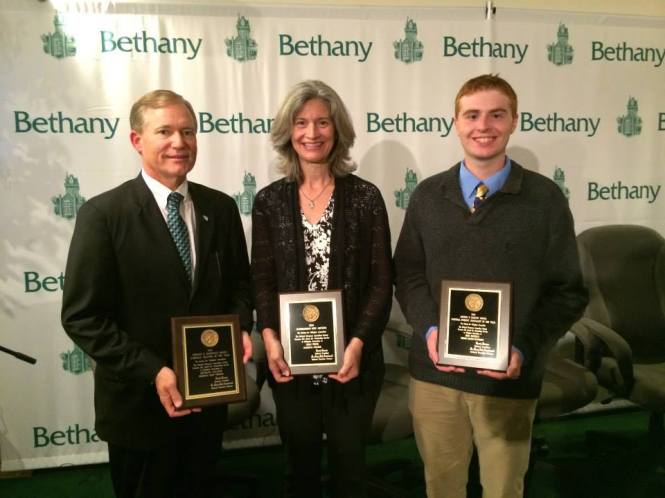
Major award winners: Dr. Scott D. Miller, president of Bethany College, accepts the award for Outstanding Chapter (Bethany College); Dr. Joan Price, Marietta College, for Outstanding New Adviser, and Nick Buzzelli, for Student Journalist of the Year. Awards were presented at the 2014 SCJ Biennial Conference at Bethany College, West Virginia.
The Barlow Award for the Student Journalist of the Year – Nicholas Buzzelli, Robert Morris University
The award is named for longtime SCJ Executive Director Arthur H. Barlow. This award is based on outstanding contributions to college journalism. It is designed to allow SCJ chapter advisers an opportunity to bring national recognition to a student journalist who meets the highest standards of ethics, service, leadership and technical skills.
The winners also receive a $500 prize from National SCJ. The 2013 Arthur H. Barlow Award for Student Journalist of the Year goes to Nicholas Buzzelli.
Nick was nominated by Anthony Moretti, Robert Morris University SCJ adviser.
SCJ Past President and former Executive Director Arthur Barlow made the selection.
In the nomination materials, Moretti wrote, “He (Nick) mentors… new staff members to ensure they are comfortable in their new roles, adjusting to being reporters and gain confidence in their journalistic abilities.
“Nick also is our incoming SCJ chapter president, after being treasurer and vice-president in past years. Through SCJ, he has volunteered with the local Manchester Craftsmen’s Guild, where he helped develop the photography and writing skills of multiple inner-city high school students; with Balancing Out Hunger, our on-campus service initiative in which RMU students donate a portion of their meal-plan dollars at the end of the semester to charity; and in the fall he will lead our new off-campus efforts involving our local Humane Society.”
Moretti sums up his nomination by writing, “In short, Nick is a star and someone who deserves recognition as a Barlow Award recipient because of his commitment to make himself and his community stronger.”
The Barker Award for Adviser of the Year – Robert Noll, John Carroll University
This award recognizes the commitment and contribution the adviser makes to an SCJ Chapter. It is named for longtime SCJ National Council member and Past President, Sheridan C. Barker. Excellent SCJ chapters thrive and endure because of the commitment of the SCJ adviser. The adviser is a mentor and a facilitator, a motivator and a link to the chapter’s past and the national organization’s future. The Barker Award recognizes such individuals who are the foundation of our national organization. It is a citation of lifelong achievement.
This year’s Barker award winner is Robert Noll, the SCJ chapter adviser at John Carroll University. SCJ Executive Director Mary Beth Earnheardt made the nomination.
“I first spoke to Bob Noll about his displeasure at the way the National Contest was being managed,” Earnheardt said. “It’s not often that I’m impressed when someone is calling to complain, but Bob wasn’t complaining because he is difficult, he was complaining because he was standing up for his students. As I came to know others who worked with Bob, it became clear that he was one of our brightest stars. The Barker Award is supposed to go to a chapter that has a strong leader and Bob has shown that he is that leader at John Carroll.”
Outstanding New Adviser – Joan Price, Marietta College
This award is given to an adviser who has advised a chapter (new or existing) for a period of no longer than 6 years and no shorter than 2 years. The purpose of this award is to recognize a new and energetic member of the SCJ family.
This year the recipient of this award is Joan Price from Marietta College. SCJ Executive Director Mary Beth Earnheardt nominated Price.
“I had the pleasure of visiting the beautiful Marietta College campus for a conference before Joan started there,” Earnheardt said. “Because I’m interested in student media I asked our hosts about their campus newspaper and was told that it was in a transition period. I was happy to see it a few years later, winning awards as part of our National Contest. I’ve never met Joan, but I picture her stepping into the job, getting the paper up to speed and being the energy her students needed to excel. I look forward to seeing what her chapter does in the coming years.”
The McDonald Award for Outstanding National Chapter – Bethany College
Edward E. McDonald spent 15 years of his retirement working tirelessly as national secretary-treasurer of Pi Delta Epsilon; the organization merged with Alpha Phi Gamma in 1975 to become SCJ. This award, in his memory, is given to a chapter that upholds the highest ideals of college student journalism. It is awarded to a long-standing chapter. This year the Bethany College chapter is our McDonald Award winner.
Former SCJ Executive Director Arthur H. Barlow and Executive Director Mary Beth Earnheardt made the nomination.
“I saw the Bethany campus and met M.E. Yancosek Gamble while doing a site visit for our Biennial National Convention,” Barlow said. “I was wowed by the energy and the commitment to quality.”
Earnheardt agreed. “Bethany represents what this award is all about,” she said. “Mort Gamble and Scott Miller have a long history with the organization. Their commitment to students is apparent in the impressive media programs they’ve built. Bethany may be in a small community, but there is nothing small about the way they do media and M.E. Yancosek Gamble has more energy and positivity than anyone I’ve ever met.”
Outstanding New Chapter – Savannah College of Art and Design – Atlanta
This award is given to a chapter that has been chartered or reactivated for a period no longer than 6 years and no shorter than 2 years. The purpose of this award is to recognize a new and energetic member of the SCJ family.
This year the recipient is Savannah College of Art and Design – Atlanta. SCJ Executive Director Mary Beth Earnheardt made the nomination.
“This is the second chapter advised by Jessica Clary and, even though it’s been chartered since 2011 they have been involved in almost everything,” she said. “They regularly do very well in the contest and we’re very pleased to count them among our new rising stars. The kids at SCAD-Atlanta do great work in all kinds of media platforms. This type of approach to journalism is becoming more and more important as we enter a world where information should be both well reported and aesthetically pleasant.”
The Ingelhart Award for Freedom of Expression – Gene Policinski
This SCJ Award recognizes a special and courageous contribution to student journalism. It is named for the “great one” of collegiate journalism, Louis Ingelhart. It is the only SCJ Award that may be awarded to non-members and it carries a $500 prize from National SCJ.
This year the award goes to Gene Policinski. Andrea Frantz, SCJ Second Vice President nominated Policinski.
Frantz wrote, “It is with pleasure that I nominate Gene Policinski for the 2014 SCJ Louis Ingelhart Award. His credentials are indisputable: Chief Operating Officer of the Newseum Institute, Senior Vice President of the First Amendment Center, and a regular First Amendment champion in sessions he has delivered to countless students and advisors at CMA. Whether he is writing about current First Amendment challenges in an op-ed, hosting a rousing “Freedom Sings” concert, or educating teachers in First Amendment bootcamp workshops, Gene is one of the nation’s foremost voices on the five freedoms guaranteed by the First Amendment and their importance to our democracy.
“It’s difficult to find any significant conversation about a First Amendment issue that has occurred in the last two decades in which Gene Policinski’s voice was not present. On a personal note, I look to Gene as a mentor and someone who inspired me to love teaching First Amendment law above almost anything else I do. His passion is infectious, and I’ve been privileged to work by his side on First Amendment sessions at CMA and in Washington D.C. at the Newseum. Always I walk away from such an experience knowing that there is more work to be done in terms of raising awareness, but also reassured that Gene is steering that particular ship.”


 Send us your induction ceremony photos to see them featured on the SCJ National NewsFeed! Email us at scjnationaloffice@gmail.com!


 scjnational.org